Collateral-Free vs Secured MSME Loan: Trade-Off
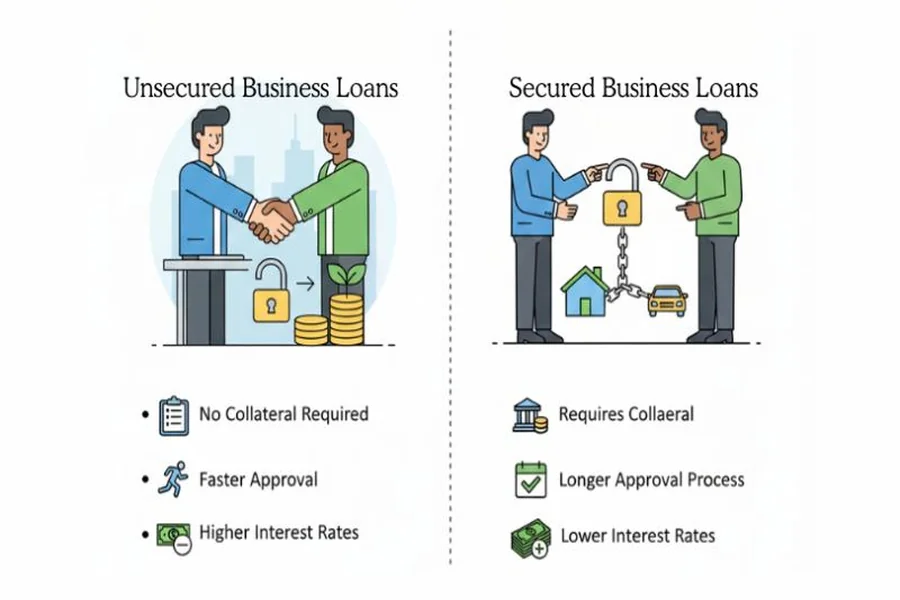
What does a collateral-free MSME loan really mean?
A msme loan without collateral needs no property, machinery or fixed deposit as security. The lender looks at your cashflow, turnover and credit history instead. You keep full ownership of your assets while you borrow.
At FlexiLoans, an unsecured facility runs on simple terms:
- Loan size: ₹50,000 to ₹50 lakh
- Interest: starting around 1% per month (about 12%+ p.a., indicative)
- Tenure: 12 to 42 months
- Minimum turnover: about ₹2 lakh a month
- Business vintage: 1 to 2 years
- Preferred CIBIL: 700+ (720+ helps for a purely unsecured loan)
- Disbursal: often within 48 to 72 hours
Government schemes also lend without collateral. The CGTMSE guarantee now covers eligible credit up to ₹5 crore. MUDRA and Stand-Up India add more collateral-free routes.
| Collateral-free route | Ticket size | Best suited for |
|---|---|---|
| MUDRA Shishu | Up to ₹50,000 | New and micro units |
| MUDRA Kishore | ₹50,001–₹5 lakh | Growing micro units |
| MUDRA Tarun | ₹5–10 lakh | Established small units |
| MUDRA Tarun Plus | ₹10–20 lakh | Scaling firms with a track record |
| CGTMSE-backed loan | Guarantee up to ₹5 crore | Larger collateral-free needs |
| Stand-Up India | ₹10 lakh–₹1 crore | Women and SC/ST greenfield ventures |
Source: MUDRA/PMMY and CGTMSE (official). Tarun Plus operational from 24 October 2024; verify live limits.
Want the full eligibility picture? Our unsecured business loan page breaks it down.
How secured business loans work and what they cost
A secured business loan works the other way. You pledge an asset — often property, plant or a deposit. The lender values it, runs legal and title checks, then lends against that security.
That security changes the deal:
- Lower interest, often around 9–16% p.a. (indicative)
- Larger tickets, since the loan tracks the asset’s value
- Longer processing, because valuation and legal work take time
- Real asset risk — miss enough EMIs and the lender can claim the asset
Banks and NBFCs set these rates within the central bank’s lending framework. The Reserve Bank of India publishes the norms that shape how lenders price and disclose loans. A secured loan rewards you with a lower rate, but it puts something you own on the line.
You can compare live pricing on our business loan interest rate page.
Collateral-free vs secured loan: the real trade-off
So which costs more? Here is the honest side-by-side.
| Factor | Collateral-free MSME loan | Secured business loan |
|---|---|---|
| Interest (indicative) | ~14–30% p.a. (FlexiLoans from ~1%/month) | ~9–16% p.a. |
| Typical max amount | ₹50,000–₹50 lakh (up to ₹5 cr via CGTMSE) | Tied to asset value; can top ₹1 crore |
| Approval basis | Turnover, cashflow, CIBIL 700+ | Asset value plus repayment ability |
| Asset at risk | None | Property or machinery pledged |
| Speed | ~48–72 hours | Weeks (valuation and legal checks) |
| Paperwork | Light, mostly digital | Heavy (valuation, title, legal) |
Ranges are indicative and vary by lender and profile; FlexiLoans unsecured terms and the CGTMSE guarantee cap appear for context. Verify live figures.
Picture a ₹20 lakh loan over 3 years. A secured rate near 11% p.a. works out to roughly ₹3.6 lakh in interest. A collateral-free rate near 15% p.a. costs about ₹5 lakh. That is close to ₹1.4 lakh extra to avoid pledging an asset — the real price of speed and safety. (Illustrative EMI math; your actual rate depends on your profile.)
When a collateral-free loan wins, and when secured wins
There is no single winner. The right pick depends on your urgency, ticket size and risk appetite.
| When collateral-free wins | When a secured loan wins |
|---|---|
| You need funds in days, not weeks | You can wait weeks for a lower rate |
| You own no property to pledge | You hold property or machinery to offer |
| Your need is under ₹50 lakh | You want a large ticket above ₹1 crore |
| You want to protect personal assets | You want the lowest possible rate |
| Turnover is steady and CIBIL is 700+ | Your credit is thin but your asset is strong |
Guidance only; lender terms and your own profile decide the final offer.
Still unsure? FlexiLoans lets you weigh both routes in one place.
How to use the trade-off tool below before you apply
Use the trade-off tool below to test both routes side by side.
Here is how to use the tool below:
- Enter your loan amount and preferred tenure.
- Toggle collateral on and off.
- Watch the rate, maximum amount and approval odds shift.
- Compare the total interest for each option.
Toggle collateral off, and you trade a lower rate for speed and safety. Toggle it on, and you trade an asset pledge for a cheaper loan. The tool turns an abstract choice into a clear rupee comparison.
How to strengthen your approval odds for either route
Your profile drives the rate and the decision. A few steps lift your odds either way:
- Keep your CIBIL score above 700; aim for 720+ for a clean unsecured deal.
- Register on Udyam so lenders can verify your MSME status quickly.
- Keep GST returns and ITRs filed and handy.
- Maintain steady bank inflows that match your stated turnover.
- Clear existing EMIs and dues on time.
For any msme loan without collateral above ₹20 lakh, keep audited financials, ITR and GST records ready. Strong books shrink the rate gap and speed up the decision, whichever route you choose.
Frequently asked questions
Q: Does a collateral-free MSME loan cost more than a secured one?
Usually, yes. A collateral-free MSME loan carries a higher rate — often 14–30% p.a. versus about 9–16% p.a. for secured credit. You pay that premium for speed and to keep your assets unpledged. Strong turnover and a CIBIL score above 700 can narrow the gap.
Q: What is the largest msme loan without collateral I can get?
It depends on the route. FlexiLoans offers unsecured loans up to ₹50 lakh. The CGTMSE guarantee can back eligible collateral-free credit up to ₹5 crore. MUDRA’s Tarun Plus lends up to ₹20 lakh without security.
Q: Will a collateral-free loan hurt my credit score?
Not by itself. On-time EMIs actually build your score, while missed payments hurt it — the same as any loan. Note that lenders may still ask for a personal guarantee, even without collateral.
Q: Can I move from a collateral-free loan to a secured one later?
Yes. Once your turnover grows or you acquire a pledgeable asset, you can refinance or transfer the balance to a lower-rate secured loan. Many owners start unsecured for speed, then refinance later.
Q: What documents does a collateral-free MSME loan need?
Expect KYC, recent bank statements, and GST returns or ITRs. Udyam registration helps your case. For loans above ₹20 lakh, keep audited financials ready. Requirements vary by lender, so confirm the live list before you apply.
The bottom line
The choice is not about which loan is “better.” It is about what you are willing to trade. A collateral-free loan buys speed and safety at a higher rate. A secured loan buys a lower rate by putting an asset at risk. Run your numbers in the tool below, then apply with clear eyes.
Ready to compare offers? Check your eligibility for an MSME loan with FlexiLoans and see your indicative terms in minutes.
Sources & official references:
- Reserve Bank of India — https://www.rbi.org.in
- CGTMSE (collateral-free credit guarantee) — https://www.cgtmse.in