5-Axis CNC Machining Boosts Precision Manufacturing Efficiency in India by 30%
Introduction
India’s precision manufacturing sector faces intensifying global competition, with traditional 3-axis CNC machining struggling to meet modern efficiency and precision requirements. Complex part geometries frequently lead to project delays and resource inefficiencies due to multiple setups and accumulated errors. The fundamental challenge lies in dependence on repetitive fixturing and limited technological integration, which compromises accuracy.
This article examines how 5-axis CNC machining, through simultaneous multi-axis movement and single-setup processing, enhances precision and productivity. The following analysis details how this advanced manufacturing technology serves as a transformative solution for Indian manufacturers seeking global competitiveness.
What Is 5-Axis CNC Machining and Its Core Advantages in Indian Manufacturing?
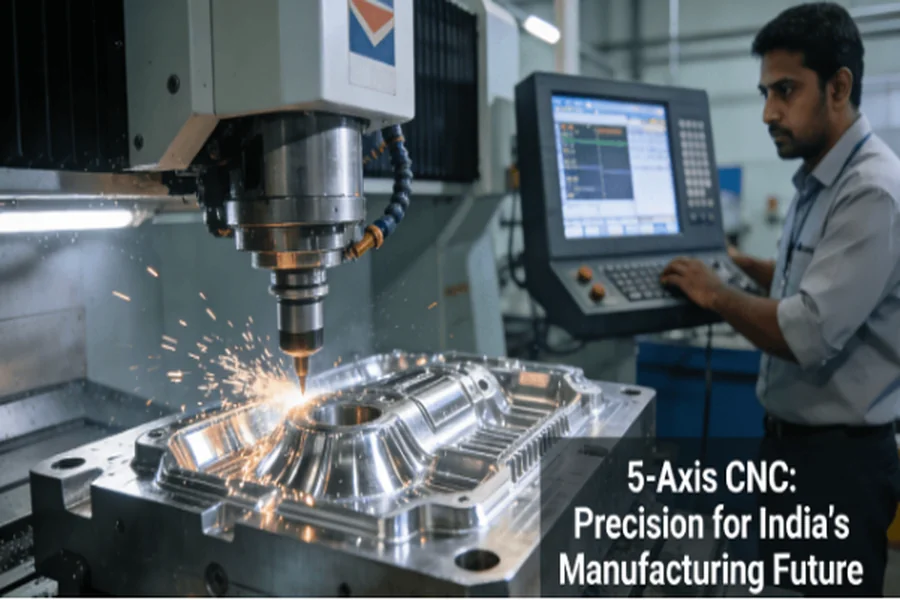
- axis CNC machining simultaneously controls three linear axes (X, Y, Z) and two rotational axes (A and C), enabling complex part production in a single setup. This technology significantly outperforms conventional 3-axis systems by reducing fixturing requirements, minimizing errors, and improving dimensional stability. In India, manufacturers have documented lead time reductions of up to 40%, with material utilization improving by 25% and tolerances within ±0.005mm.
- Various machine configurations—including table-table, head-head, and table-head designs—cater to different applications, from heavy workpieces to large components. While challenges like high initial investment and specialized skill requirements exist, these can be mitigated through phased implementation, government subsidies, and technology partnerships, making 5-axis machining increasingly accessible for India’s diverse manufacturing sectors.
How to Select Materials for 5-Axis CNC Machining to Optimize Performance?
Material selection critically influences the efficiency and outcomes of Multi Axis CNC Materials processing. Metals like aluminum alloys and titanium provide excellent strength-to-weight ratios, while engineering plastics facilitate rapid prototyping applications. Manufacturers must carefully balance material hardness, thermal stability, and cost factors to maximize performance. The enhanced capabilities of 5-axis machining allow for processing a wider range of materials than conventional methods, including difficult-to-machine super alloys and composites that are increasingly important for high-tech industries.
The table below illustrates the performance characteristics of commonly used metals in 5-axis machining:
| Material | Tensile Strength (MPa) | Machinability Rating | Typical Applications |
|---|---|---|---|
| Aluminum 6061 | 310 | Excellent | Automotive, aerospace |
| Titanium Grade 5 | 950 | Difficult | Medical, aerospace |
| Stainless Steel 304 | 505 | Moderate | Food processing, medical |
| Inconel 718 | 1350 | Very Difficult | Turbine components |
Non-Metallic Materials for Prototyping Needs
Engineering plastics including PEEK and nylon enable rapid design iterations. A Bengaluru medical technology startup leveraged CNC machining multi-material compatibility to reduce prototype development duration from six weeks to just ten days. The versatility of 5-axis machining allows for efficient processing of these materials, enabling manufacturers to create complex prototypes that closely mimic final production parts.
Comprehensive Material Selection Guidelines
Technical considerations like machinability and post-processing requirements significantly influence material suitability. Adherence to ISO material standards ensures consistent quality. Indian manufacturing enterprises can achieve 30% faster market entry by strategically aligning material properties with 5-axis machining capabilities. Factors such as chip formation, thermal conductivity, and tool wear characteristics must be considered when selecting materials for specific applications.
Can 5-Axis CNC Machining Achieve Tolerances of ±0.005mm for High-Precision Demands?
Advanced 5-Axis Machining Tolerances routinely maintain precision within ±0.005mm, exceeding ISO 2768 benchmarks. By eliminating repositioning errors, this technology ensures exceptional uniformity across complex geometrical features. A Coimbatore-based precision engineering firm reported a 50% reduction in scrap rates after transitioning to 5-axis systems.
Sophisticated toolpath optimization combined with precise temperature control further enhances machining accuracy. For Indian manufacturers, this precision level facilitates better compliance with international quality standards, as detailed in ISO tolerancing guidelines.
What Are the Successful Applications of 5-Axis CNC Machining in Indian Precision Manufacturing?
Indian industrial sectors are increasingly adopting multi-axis machining solutions to overcome complex design and manufacturing challenges. The technology’s versatility enables its application across diverse industries, from traditional manufacturing sectors to emerging high-tech fields. This widespread adoption demonstrates the technology’s ability to address various production challenges while delivering consistent quality and efficiency improvements.
Automotive Manufacturing Sector
A Gurgaon-based automotive component supplier implemented 5-axis machining for transmission housing production, achieving 30% reduction in machining time while decreasing tooling expenses. The ability to machine complex features in a single setup eliminated alignment errors and improved overall component quality. This application demonstrates how India Precision Manufacturing can leverage advanced technology to enhance competitiveness in global automotive supply chains.
Aerospace and Defense Applications
Complex turbine blades manufactured in Hyderabad met stringent AS9100D standards, achieving 35% weight reduction alongside improved aerodynamic performance characteristics. The 5-axis machining process enabled precise control over blade geometry, including complex cooling channels and aerodynamic surfaces that would be impossible to produce using conventional machining methods.
-
Medical Equipment Manufacturing
Surgical implants produced in Mumbai facilities achieved 99% dimensional accuracy, fully complying with ISO 13485 medical device standards. The clean machining environment and precise temperature control required for medical component production highlight how 5-axis technology supports manufacturing of critical healthcare components. This capability positions Indian manufacturers as reliable suppliers in the global medical device market.
-
Energy Sector Applications
Turbine components for power generation equipment represent another successful application of 5-axis machining in India. The ability to machine complex curved surfaces and precise mating features ensures optimal performance in demanding energy generation environments. Indian companies supplying these components have gained recognition for quality and reliability in international markets.
-
Economic Impact Analysis
An AMT research study demonstrated that 5-axis adoption increased productivity by 40% among Indian small and medium enterprises. Professional services like 5 Axis CNC Machining Services enable local suppliers to enhance their global competitiveness significantly. The study further indicated that companies investing in 5-axis technology typically see return on investment within 18-24 months through improved efficiency and reduced scrap rates.
How to Evaluate the Cost-Benefit of Investing in 5-Axis CNC Machining in the Indian Market?
Total Cost of Ownership Analysis
Beyond initial acquisition costs, manufacturers must evaluate the total cost of ownership including maintenance, tooling, energy consumption, and training requirements. Modern 5-axis machines feature energy-efficient components and require less maintenance than older technologies, contributing to lower lifetime operating costs. These factors enhance the technology’s accessibility for Indian manufacturers across different scales of operation.
- Maintenance and Energy Efficiency Considerations
Modern 5-axis machines incorporate energy-saving features and reduced maintenance needs, significantly lowering operational expenses over the equipment’s lifespan. These advancements make the technology more sustainable and cost-effective for long-term implementation in Indian manufacturing facilities.
- Tooling and Training Investment Requirements
While advanced tooling systems and specialized training represent additional costs, they are essential for maximizing machine utilization and achieving optimal performance. Proper investment in these areas ensures higher productivity and better return on investment for Indian manufacturers.
Financing and Implementation Strategies
Various financing options and government support schemes help overcome initial investment barriers. Technology upgradation schemes, soft loans, and strategic partnerships make 5-axis machining financially viable, particularly for small and medium enterprises. Many Indian states offer specific incentives for advanced manufacturing technology adoption, supporting broader implementation across the industrial sector.
Conclusion
- axis CNC machining elevates India’s precision manufacturing sector by delivering exceptional accuracy, operational efficiency, and production flexibility. This advanced technology enables Indian manufacturers to overcome traditional constraints and accelerate their integration into global supply chains. Its capacity to produce complex, high-precision components strengthens India’s position in international markets. As manufacturing technology progresses, adopting 5-axis machining is becoming essential for maintaining competitive advantage.
Successful implementation requires strategic planning, workforce training, and seamless integration with existing processes. By collaborating with technical specialists and executing properly, Indian manufacturers can achieve substantial gains in product quality, production efficiency, and overall profitability, ensuring sustainable growth in the global marketplace.
Author Bio
The author is a precision manufacturing specialist with extensive industry experience. This article receives technical support from the JS Precision engineering team, which brings decades of combined experience in advanced manufacturing technologies. The team’s expertise spans multiple industries and applications, providing valuable insights into practical implementation challenges and solutions.
FAQs
Q: Is 5-axis CNC machining suitable for small-batch production?
A: The technology significantly reduces setup requirements, enabling economical low-volume production runs ideal for India’s diverse market demands. The flexibility of 5-axis machining makes it particularly suitable for prototype development and small-batch production where quick turnaround times are essential.
Q: How to ensure material stability during 5-axis machining?
A: Selection of thermally resistant materials like aluminum combined with controlled cutting parameters minimizes deformation risks. Proper fixturing, optimized cutting strategies, and appropriate cooling techniques further enhance material stability during the machining process.
Q: What are common challenges of adopting 5-axis CNC in India?
A: High capital investment and technical skill requirements present challenges, addressable through phased implementation and training programs. Additional challenges include the need for advanced programming capabilities and potential requirements for facility modifications to accommodate new equipment.
Q: Can ±0.005mm tolerance be achieved on all materials?
A: Difficult-to-machine materials like titanium require specialized tooling, but precision standards are achievable through optimized processes. The achievement of tight tolerances depends on multiple factors including material characteristics, machine capability, and cutting tool selection.
Q: How long does it take to recover 5-axis machining investment costs?
A: Most Indian manufacturing businesses achieve breakeven within 1-2 years through reduced operational waste and improved delivery performance. The exact payback period depends on factors such as production volume, part complexity, and operational efficiency improvements.
Q: What maintenance requirements do 5-axis machines have?
A: Regular maintenance including calibration, lubrication, and component inspection ensures long-term accuracy and reliability. Preventive maintenance schedules typically include daily, weekly, and monthly tasks to maintain optimal machine performance.
Q: How does 5-axis machining support sustainable manufacturing?
A: The technology supports sustainability through reduced material waste, lower energy consumption per part, and decreased need for multiple machines. These factors contribute to improved environmental performance while maintaining manufacturing efficiency.